

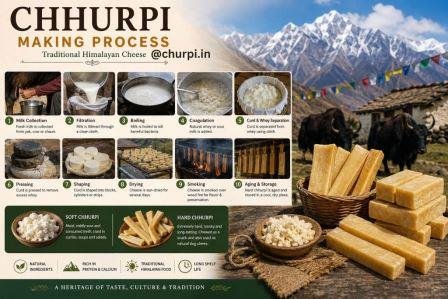
Chhurpi Making Process: Traditional Himalayan Cheese Production Explained
Introduction
Chhurpi is one of the oldest and most fascinating dairy products of the Himalayan region. Known for its remarkable hardness, smoky aroma, long shelf life, and nutritional richness, Chhurpi represents centuries of indigenous dairy knowledge preserved by mountain communities across Nepal, Sikkim, Bhutan, Darjeeling, Arunachal Pradesh, Ladakh, and Tibetan regions.
Often referred to as a traditional Himalayan cheese, Chhurpi is a fermented dairy product made primarily from yak milk, cow milk, chauri milk, buffalo milk, or mixed milk varieties. The cheese exists in two primary forms: soft Chhurpi and hard Chhurpi. While soft Chhurpi resembles cottage cheese with a mild flavor and moist texture, hard Chhurpi is extremely dense and chewy, sometimes consumed over several hours due to its hardness.
The Chhurpi making process combines traditional artisanal cheese making methods with natural fermentation, milk coagulation, whey separation, pressing, smoking, and drying techniques adapted specifically to high-altitude Himalayan climates. Unlike many industrial cheeses, Chhurpi production often relies on indigenous dairy practices passed orally through generations.
The uniqueness of Chhurpi lies not only in its taste and preservation method but also in its cultural and economic importance. In remote mountain communities where refrigeration was historically unavailable, Churpi became an essential protein-rich food with exceptional shelf stability. Today, it is also globally recognized as a natural dog chew exported to Europe and North America.
Image Suggestion
- Himalayan yak herders carrying milk containers in mountain villages
- Traditional Chhurpi drying racks in Sikkim or Nepal
Origin and History of Chhurpi
The history of Chhurpi is deeply connected with Himalayan pastoral societies. For centuries, yak herders and mountain farmers needed methods to preserve excess milk in harsh climatic conditions. Fermentation and drying became practical preservation techniques long before modern refrigeration existed.
Historical evidence suggests that Chhurpi originated in Tibetan and Himalayan regions where yak husbandry was common. Over time, the practice spread across:
- Eastern Himalayas
- Tibetan Plateau
- Nepalese hill communities
- Bhutanese settlements
- Sikkimese pastoral regions
- Darjeeling Himalayan villages
Different ethnic groups developed their own variations of the Chhurpi making process. Sherpas, Bhutias, Lepchas, Tamangs, and Tibetan communities all contributed to the evolution of this traditional cheese.
In many Himalayan monasteries, Chhurpi served as an important source of nutrition for monks during long winters. Traders also carried hard Chhurpi along ancient mountain trade routes because of its portability and resistance to spoilage.
Did You Know?
Hard Chhurpi can remain edible for months or even years when properly dried and stored in cool mountain environments.
Regions Where Chhurpi Is Made
Sikkim
Sikkim is one of the most well-known centers of Chhurpi production in India. The cool climate, abundance of cattle and yak hybrids, and strong dairy traditions make the state ideal for artisanal cheese making.
Soft Chhurpi is widely consumed with rice, vegetables, and fermented foods, while hard Chhurpi is commonly chewed as a snack.
Image Suggestion
- Village dairy farms in North Sikkim
- Traditional Sikkimese kitchens preparing Chhurpi
Darjeeling
Darjeeling’s Nepali-speaking communities produce both soft and smoked varieties of Chhurpi. Local methods often include hanging the cheese above kitchen fireplaces, which imparts a distinctive smoky flavor.
Nepal
Nepal is among the largest traditional producers of Chhurpi. Himalayan yak cheese production is especially prominent in high-altitude regions such as:
- Solukhumbu
- Dolakha
- Mustang
- Rasuwa
Nepal has also become a major exporter of Chhurpi dog chews.
Bhutan
Bhutanese cheese-making traditions include dried cottage cheese forms similar to Chhurpi. The cheese is often incorporated into stews and traditional dishes.
Arunachal Pradesh
Monpa and Tibetan-origin communities in Arunachal Pradesh prepare fermented dairy products closely related to Chhurpi using yak and cattle milk.
Ladakh
Ladakhi communities prepare sun-dried cheese products adapted to cold desert conditions. Fermentation and moisture reduction are essential preservation strategies in the region.
Tibetan Regions
Tibetan pastoral communities have long relied on yak milk cheese products for survival in high-altitude conditions. Chhurpi-like products remain part of nomadic diets.
Types of Chhurpi
Soft Chhurpi
Soft Chhurpi is moist, mildly sour, and resembles cottage cheese or ricotta in texture.
Characteristics
- White or cream colored
- Moist texture
- Mildly tangy flavor
- Short shelf life
- Consumed fresh
Common Uses
- Mixed with vegetables
- Added to soups
- Consumed with rice
- Fried or sautéed
Hard Chhurpi
Hard Chhurpi is the dried and compressed form of soft cheese.
Characteristics
- Extremely hard texture
- Smoky aroma
- Long shelf life
- Dense protein structure
- Chewy consistency
Common Uses
- Traditional snack
- Travel food
- Dog chew product
- Emergency protein source
Comparison Table
| Feature | Soft Chhurpi | Hard Chhurpi |
|---|---|---|
| Moisture | High | Very low |
| Texture | Soft | Extremely hard |
| Shelf Life | Few days | Months to years |
| Taste | Mild and sour | Smoky and nutty |
| Preparation | Minimal drying | Extensive drying |
| Consumption | Fresh food | Chewed snack |
Milk Used in Chhurpi Production
Yak Milk
Yak milk is highly valued for Chhurpi making due to:
- High fat content
- Rich protein composition
- Dense nutritional profile
Yak milk produces richer and more flavorful cheese.
Chauri Milk
Chauri are yak-cow hybrids commonly found in Himalayan regions. Their milk combines:
- Better yield
- Moderate fat content
- Improved adaptability
Chauri milk is widely used in commercial Chhurpi production.
Cow Milk
Cow milk is commonly used in lower Himalayan elevations where yak populations are limited.
Buffalo Milk
Buffalo milk creates softer and creamier Chhurpi because of its elevated fat levels.
Goat Milk
Some communities use goat milk in small-scale artisanal production.
Seasonal Milk Variations
Milk quality changes significantly according to:
- Grazing conditions
- Temperature
- Altitude
- Seasonal vegetation
Summer milk generally contains higher nutritional quality due to richer pasture access.
Traditional Chhurpi Making Process
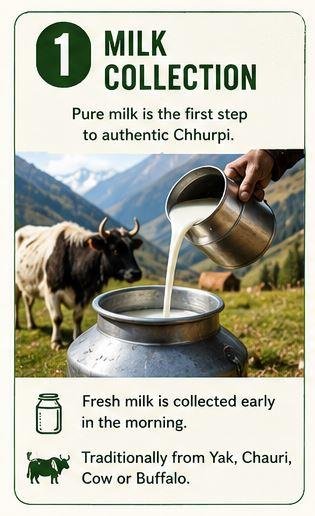
Step 1: Milk Collection
Fresh milk is collected early in the morning from yaks, cows, or chauri animals.
Important Considerations
- Clean milking practices
- Immediate processing
- Avoiding bacterial contamination
Traditionally, milk is stored in metal or clay containers before processing.
Step 2: Filtration
The milk is filtered through cotton cloths to remove:
- Dirt
- Hair
- Grass particles
- Sediments
This improves the purity and texture of the final cheese.
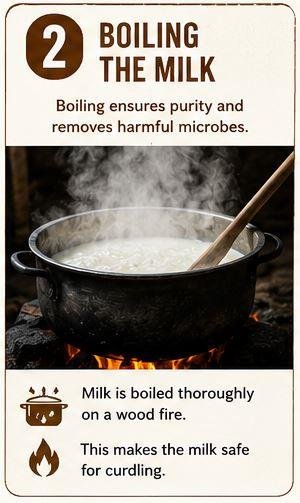
Step 3: Boiling Process
The filtered milk is heated in large vessels.
Scientific Purpose
Boiling:
- Destroys harmful microbes
- Denatures whey proteins
- Improves coagulation efficiency
The milk is typically heated to near boiling temperatures without vigorous overheating.
Step 4: Cooling Stage
After heating, the milk is partially cooled.
Temperature control is critical because excessive heat can interfere with curd formation.
Step 5: Coagulation Methods
Milk coagulation is one of the most important stages in the Chhurpi making process.
Traditional coagulants include:
- Sour buttermilk
- Fermented whey
- Natural acids
- Previous batch cultures
The acidic environment causes casein proteins to coagulate.
Step 6: Curd Formation
As acidity increases, milk solids separate into:
- Curds
- Whey
The curd becomes thicker and forms a soft mass.
Step 7: Whey Separation
The curds are transferred into cloth bags for whey drainage.
Traditional Methods
- Hanging cloth bags
- Bamboo baskets
- Gravity draining
This process significantly reduces moisture.
Step 8: Pressing Techniques
The curd mass is compressed using:
- Stone weights
- Wooden presses
- Hand pressing
Pressing:
- Removes excess whey
- Increases density
- Improves preservation
Step 9: Shaping Methods
The cheese is shaped into:
- Blocks
- Cubes
- Strips
- Cylinders
Shape affects drying efficiency and texture.
Step 10: Drying Process
Drying is essential for producing hard Chhurpi.
Drying Methods
- Sun drying
- Air drying
- Smoke drying
Moisture reduction prevents microbial spoilage.
Step 11: Smoking Process
In many Himalayan homes, Chhurpi is suspended above kitchen fireplaces.
Smoke exposure:
- Adds flavor
- Enhances preservation
- Reduces moisture
This creates the characteristic smoky aroma.
Step 12: Sun Drying
Cheese pieces are exposed to sunlight for several days or weeks.
Benefits
- Natural dehydration
- Reduced water activity
- Increased shelf stability
Step 13: Fermentation
Natural fermentation occurs throughout production.
Role of Fermentation
- Flavor development
- Preservation
- Nutritional enhancement
Lactic acid bacteria play a major role in this stage.
Step 14: Aging and Preservation
Some hard Chhurpi is aged for extended periods.
Aging contributes to:
- Flavor intensification
- Texture hardening
- Moisture stabilization
Traditional Tools and Equipment
Wooden Churners
Used for stirring and butter extraction.
Bamboo Baskets
Assist in drainage and shaping.
Cotton Cloths
Essential for whey separation.
Stone Presses
Provide natural compression.
Clay Pots
Used for fermentation and storage.
Modern Machinery Comparison
| Traditional Method | Modern Method |
|---|---|
| Hand pressing | Hydraulic pressing |
| Sun drying | Mechanical dehydrators |
| Natural fermentation | Controlled cultures |
| Smoke drying | Industrial drying chambers |
Scientific Explanation of Chhurpi Production
Fermentation Science
Fermentation is driven primarily by lactic acid bacteria.
These microorganisms:
- Convert lactose into lactic acid
- Lower pH
- Improve preservation
Protein Coagulation
Casein proteins coagulate under acidic conditions.
This creates:
- Curd formation
- Texture development
- Protein concentration
Moisture Reduction
Water activity is reduced through drying.
Lower moisture:
- Prevents bacterial growth
- Extends shelf life
- Increases hardness
Nutritional Transformation
Fermentation may improve:
- Digestibility
- Mineral availability
- Protein concentration
Hard Chhurpi Production Process
Preparation
Soft curd is first prepared through coagulation.
Compression
Heavy pressing removes maximum moisture.
Drying Duration
Drying may last:
- Several days
- Weeks
- Even months
depending on climate.
Hardening
The protein matrix gradually becomes extremely dense.
Storage
Hard Chhurpi is stored in:
- Dry rooms
- Cloth bags
- Wooden containers
Soft Chhurpi Production Process
Moist Cheese Preparation
Soft Chhurpi undergoes minimal drying.
Consumption Methods
It is commonly:
- Fried
- Curried
- Mixed with vegetables
Shelf Life
Soft Chhurpi must be consumed relatively quickly.
Fermentation and Drying Techniques
Natural Fermentation
Relies on environmental microorganisms.
Smoke Drying
Provides:
- Preservation
- Flavor enhancement
- Insect protection
Sun Drying
A low-cost traditional dehydration method.
Air Drying
Mountain winds help remove moisture naturally.
Nutritional Value of Chhurpi
| Nutrient | Approximate Value |
|---|---|
| Protein | High |
| Calcium | Very high |
| Fat | Moderate to high |
| Calories | Dense |
| Vitamin B12 | Present |
| Phosphorus | High |
Health Benefits
- High protein content
- Rich calcium source
- Long-lasting energy
- Portable nutrition
Drawbacks
- High sodium in some varieties
- Extremely hard texture
- Difficult chewing for some individuals
Role of Chhurpi in Himalayan Culture
Festivals
Chhurpi is often served during:
- Harvest celebrations
- Religious gatherings
- Community feasts
Rural Livelihood
Cheese production supports:
- Dairy farmers
- Women-led households
- Mountain economies
Traditional Hospitality
Offering Chhurpi to guests symbolizes warmth and respect.
Chhurpi as Dog Chew
In recent decades, hard Chhurpi gained popularity as a natural dog chew.
Reasons for Popularity
- Long-lasting
- High protein
- Chemical-free
- Digestible
Export Market
Major export destinations include:
- United States
- Europe
- Japan
Hygiene and Safety in Chhurpi Making
Traditional Hygiene
Communities traditionally relied on:
- Smoke sanitation
- Boiling
- Sunlight exposure
Modern Food Safety
Commercial production now includes:
- Pasteurization
- Hygienic packaging
- Laboratory testing
Industrial vs Traditional Chhurpi Production
| Feature | Traditional | Industrial |
|---|---|---|
| Scale | Small | Large |
| Drying | Natural | Mechanical |
| Flavor | Complex | Standardized |
| Fermentation | Natural | Controlled |
| Shelf Life | Variable | Predictable |
Challenges in Chhurpi Production
Climate Change
Changing weather affects:
- Pasture quality
- Milk yield
- Drying conditions
Decline in Yak Population
Reduced yak farming threatens traditional yak milk cheese production.
Commercialization
Mass production may reduce artisanal quality.
Modern Innovations
Vacuum Drying
Improves:
- Hygiene
- Speed
- Consistency
Packaging
Modern vacuum packaging extends shelf life.
Organic Certification
Organic Himalayan cheese markets are growing internationally.
Economic Importance
Chhurpi production contributes significantly to:
- Rural employment
- Tourism
- Export income
- Dairy cooperatives
Sustainability and Environmental Impact
Traditional Himalayan dairy systems are often:
- Low waste
- Grazing-based
- Environmentally adaptive
Indigenous dairy knowledge promotes sustainable mountain livelihoods.
Storage and Shelf Life
Traditional Storage
- Cloth wrapping
- Dry hanging
- Smoke exposure
Modern Storage
- Vacuum packs
- Refrigeration
- Moisture barriers
How to Make Chhurpi at Home
Ingredients
- 2 liters milk
- Lemon juice or sour whey
- Cheese cloth
Equipment
- Pot
- Strainer
- Pressing weight
Step-by-Step Instructions
- Heat milk.
- Add acid slowly.
- Allow curd formation.
- Separate whey.
- Press curd.
- Shape cheese.
- Dry under sunlight.
Tips
- Avoid overheating.
- Use fresh milk.
- Ensure proper drying.
Common Mistakes in Chhurpi Making
Overheating Milk
Can damage protein structure.
Poor Coagulation
Occurs due to incorrect acidity.
Insufficient Drying
Leads to spoilage.
Mold Contamination
Improper storage encourages fungal growth.
Frequently Asked Questions (FAQs)
1. What is Chhurpi made from?
Chhurpi is traditionally made from yak, cow, buffalo, or chauri milk.
2. Why is hard Chhurpi so hard?
Extensive drying removes most moisture, creating a dense protein structure.
3. Is Chhurpi fermented?
Yes, natural fermentation is central to the process.
4. Is Chhurpi healthy?
It is rich in protein and calcium.
5. Can Chhurpi spoil?
Improperly dried Chhurpi may develop mold.
6. What does Chhurpi taste like?
Soft Chhurpi is mildly sour, while hard Chhurpi is smoky and nutty.
7. How long does hard Chhurpi last?
Several months to years under dry conditions.
8. Why is Chhurpi popular as dog chew?
Its hardness and digestibility make it ideal.
9. Is yak milk necessary?
No, cow milk can also be used.
10. Is Chhurpi vegetarian?
Traditionally yes, because natural acids are used instead of animal rennet.
11. Can Chhurpi be refrigerated?
Soft Chhurpi should be refrigerated.
12. Is Chhurpi similar to cottage cheese?
Soft Chhurpi resembles cottage cheese.
13. What bacteria are involved in fermentation?
Primarily lactic acid bacteria.
14. Does Chhurpi contain probiotics?
Some varieties may contain beneficial microbes.
15. Why is smoking used?
Smoking improves preservation and flavor.
16. Is Chhurpi eaten daily?
In many Himalayan communities, yes.
17. Can goat milk be used?
Yes, though less commonly.
18. Is Chhurpi expensive?
Yak milk varieties are generally costly.
19. What climate is best for drying?
Cold and dry Himalayan climates are ideal.
20. Is industrial Chhurpi different?
Yes, industrial production uses modern machinery and standardized processing.
Suggested Internal Linking Opportunities
- History of Himalayan Cuisine
- Yak Milk Nutrition
- Traditional Fermented Foods of Nepal
- Sikkimese Food Culture
- Himalayan Dairy Farming
- Fermented Cheese Around the World
Conclusion
The Chhurpi making process is a remarkable example of Himalayan food wisdom shaped by geography, climate, and cultural necessity. Through centuries of experimentation and adaptation, mountain communities developed a highly nutritious fermented cheese capable of surviving harsh environmental conditions without refrigeration.
From milk collection and coagulation to pressing, smoking, fermentation, and drying, every stage reflects a deep understanding of preservation science and indigenous dairy practices. Both soft Chhurpi and hard Chhurpi continue to play important roles in Himalayan diets, local economies, and cultural traditions.
Today, Chhurpi stands at the intersection of heritage and globalization. While traditional methods remain central to its identity, modern innovations in hygiene, packaging, and export processing are expanding its international recognition. Preserving authentic artisanal techniques while embracing sustainable modernization will be essential for the future of this iconic Himalayan dairy product.